Tuesday, November 30, 2010

Power for Scotland: Zero carbon

2010 has seen - at least in the first half of the year - a fair bit of pessimism on climate change action, particularly government policy. But, with the US National Academy of Science saying warming is a settled fact, many governments have continued to act regardless of slow progress on a global agreement.

Scotland's First Minister Alex Salmond is a good example. He says green energy is a pivotal turning point in human history. Scotland has committed to 80% green electricity by 2020 and reportedly 100% by 2025. Technologies include offshore wind and the world's largest tidal turbine.

The Scotland's overall emissions cut target is 42% by 2020. Recent research finds a 40% European wide cut is achievable by 2020. And the payoffs are substantial with HSBC estimating a global low carbon economic opportunity of up to USD 2.7 trillion by 2020.

Image: Visit Scotland

Monday, November 22, 2010

Your sustainability business case

Most people agree a business case for sustainability is critical. However, the initial findings from the Massachusetts Institute of Technology's Sloan Management Review 2010 sustainability survey finds nearly half of its responders have not yet developed one. But they are spending money on it anyway.

The full report is set to be release in January 2011. Check here for details. Early results include finding:
  • Forty-seven percent of those who are substantially outperforming their peers have developed a business case for sustainability.
  • Among lower performing companies, only thirty percent have developed a business case for sustainability.
  • Fifty percent of North American companies have yet to try to develop a business case for sustainability efforts, compared to thirty percent in the Asia-Pacific region.
At the same time potential profits are substantial. Just one example - GE has announced an expected nearly $0.5 billion of revenue in 3 years catalysed by buying (not selling) clean technology electric cars.

All of which leaves open questions. What's holding other companies back?

A clear business case needs more than the profit numbers. For effective leading sustainability change its about managing the visible objective measured change as well as viewpoints, values and cultural world-views that sit beneath this - the invisible drivers. In other words, a sustainability case that is right for the organisation.

Google to Shweeb: Clean Transit

Want to fly above traffic propelled by your own legs? That's the inspiration for Schweeb (pictured) inspired from Tokyo.

It may sound a little unlikely but Google has invested $1 million in the project. The Schweeb is one of 5 winners, out of 150,000 ideas of Google's, 10 to the power of a 100 project.

10^100 is a call for ideas to change the world by helping as many people as possible.

Thursday, October 28, 2010

What's it worth? 60 billion AUD?

Valuing natural assets, like near pristine bushland and water catchments, is not always easy. Dr David Suzuki, at a recent Legacy Lecture in Adelaide, put it succinctly saying: 'in his view it was no longer acceptable to damage pristine environmental systems - there are far too few of them left'.

The Australian New South Wales Planning Assessment Commission agrees. In its Project Assessment of BHP's 60 billion dollar coal project - just outside of Sydney - it found:

"the level of impacts proposed ... for some significant natural features are no longer acceptable practice. ... The Panel is of the view that it is no longer a viable proposition for mining to cause more than negligible damage to pristine or near-pristine waterways in drinking water catchments or where these waterways are elements of significant conservation areas or significant river systems."

BHP Billiton, after previously holding the project was only viable with mining under this area of significance have now revised the project. The decision effectively puts a high value on significant natural assets. Arguably, the difference between the previous project's value and the new significantly reduced mining proposal.

Friday, October 22, 2010

Tipping Point Australia

Graham F Smith Peace Trust Annual Dinner 2005
Sustainability is obviously more than numbers and measurement. We know this but sometimes decision making loses sight of our motivations. Consequently, art has a big role to play.

Next week Waking in fear and living in hope – what kind of art do we need now? the first of 3 forums in Melbourne, Sydney and Brisbane kicks off.

Re-imagining a global future through dialogue and action TippingPointAustralia explore ways we can adapt to and mitigate functionally, culturally and socially the effects of climate change.

There are free public events covering hope to silver linings to citizenship.

The synergy between art and sustainability is strong. The picture above is in my 2005 Graham F Smith Peace Trust dinner talk - full talk and pictures are here. And this year the integration was partly the subject of a joint USA Harvard, Australia and China Climate Change and Society colloquium here.

Or, for an environmental self portrait of America, see Chris Jordan's great site (click the pictures to zoom)! Plus check the full list of TippingPoint speakers, participants and their websites.

Tuesday, October 19, 2010

Global carbon prices and wind power growth

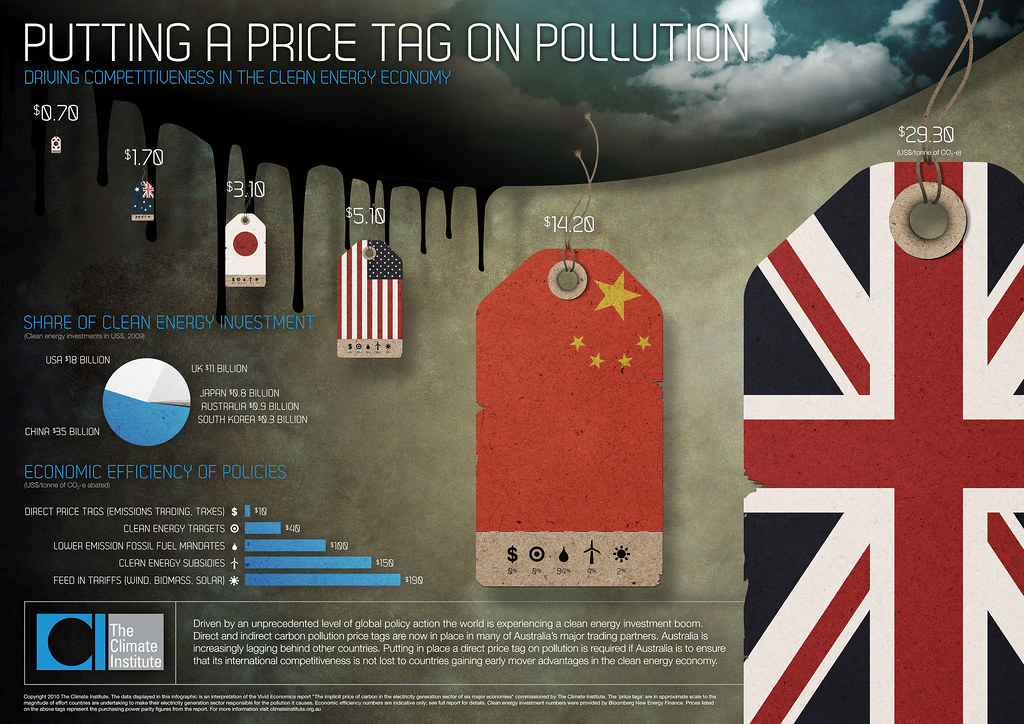
If Australia puts a price on carbon - tax or trading - we are not going it alone.

The Climate Institute commissioned Vivid Economics to look at electricity in Australia, China, Japan, South Korea, the United Kingdom and the United States.

It compared clean energy incentives and carbon costs - the graphic illustrates 2010.

Australia has the second lowest price, which arguably results in far less innovation and support for clean technology growth. And the impact is tangible with Chinese wind power capacity now greater than the USA. Its set to expand by another nine America's in the next 10 years.

Climate institute report here, Greenpeace and Global Wind Energy Council here.

Sunday, October 10, 2010

6.6 trillion USD

Hot on the heels of the Carbon Disclosure Project's 2010 report the United Nations has just released its global environmental damage assessment.

At a staggering $ 6.6 trillion - equivalent to 11% of global GDP for damage caused by human activity in 2008 - its bigger than the Global Financial Crisis.

The study projects that the monetary value - from water and air pollution, greenhouse gas emissions, general waste and depleted resources - could reach $28.6 trillion in 2050.

Other study headlines include:
  • The top global 3,000 public companies were responsible for $ 2.15 trillion worth of environmental damage in 2008.
  • More than 50 percent of company earnings could be at risk from environmental costs (in an equally weighted portfolio).
  • Damage costs are generally higher than the cost of preventing or limiting pollution and resource depletion.

UN PRI and UNEP Why environmental externalities matter to institutional investors Executive Summary here.